
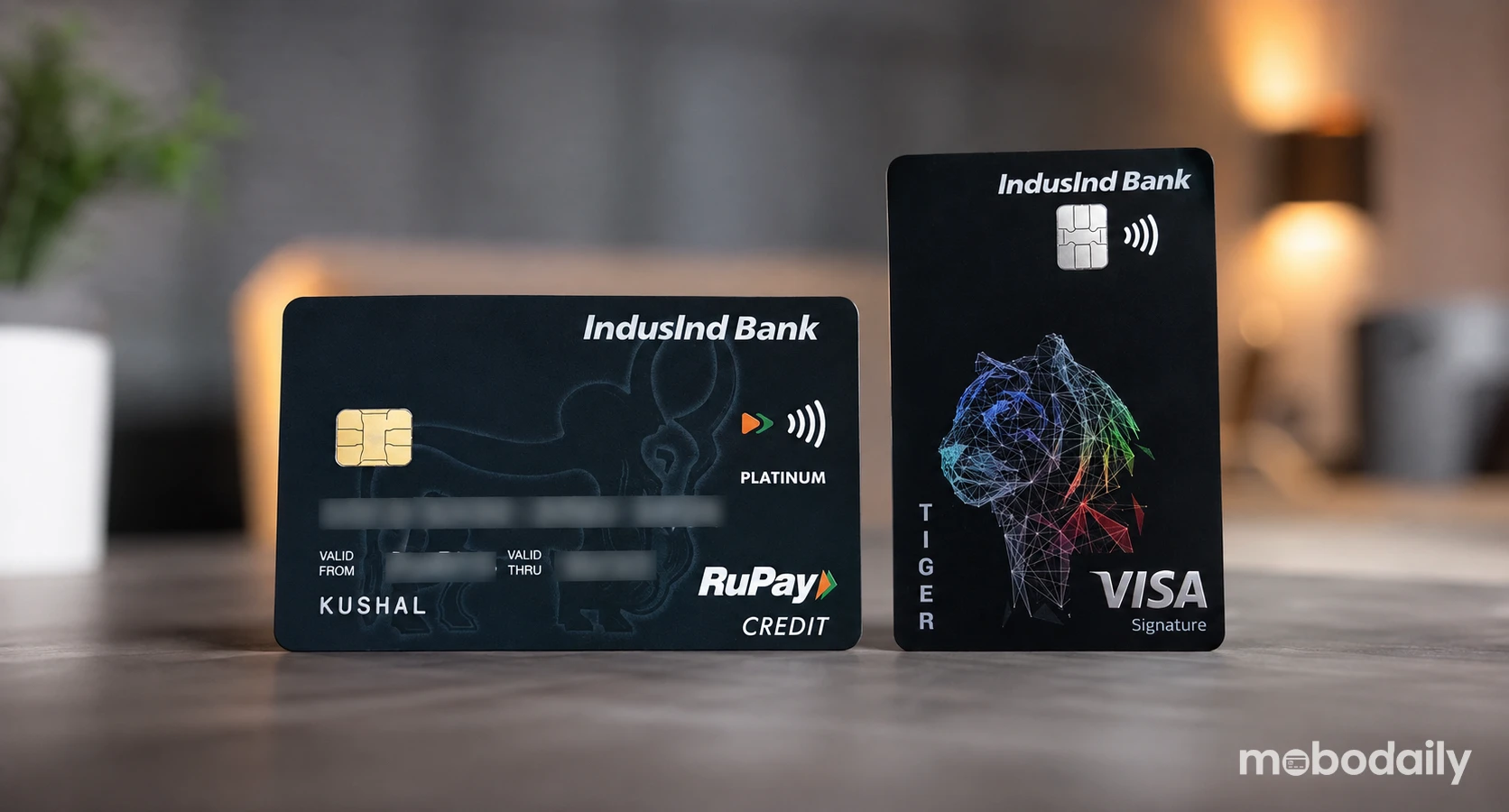
Both are genuinely lifetime-free IndusInd cards, and I’ve personally used both — but the common assumption that Tiger is a strict upgrade over Platinum RuPay isn’t quite right.
At lower spend levels, the RuPay card actually earns you more.
Here’s the real, numbers-first breakdown, drawn from my reviews on Platinum RuPay and Tiger, plus additional research.
Quick Comparison
| Parameter | Platinum RuPay | Tiger |
|---|---|---|
| Network | RuPay | Visa Signature |
| Annual Fee | ₹0 – Lifetime Free | ₹0 – Lifetime Free |
| Forex Markup | 3.5% + GST | 1.5% + GST |
| Reward Rate | 2 RP / ₹100 on UPI — up to 1.2% | 1–6 RP / ₹100, slab-based |
| Domestic Lounge | None | 8/year, no spend condition |
| International Lounge | None | 2/year (Priority Pass) |
| Free Movie Tickets | None | 2/year (up to ₹500 each) |
| Redemption | Cash, vouchers, KrisFlyer | Cash, vouchers, Air India Maharaja Club, KrisFlyer |
| Eligibility | First-time IndusInd customers only | Open application/upgrade, subject to approval |
| Mobodaily Rating | 4/5 | 4.8/5 |
| Best For | UPI-heavy spenders | Lounge Access & Air India Maharaja Club points |
| Apply | IndusInd Platinum → | IndusInd Tiger → |
Fees & Forex
| Charge | Platinum RuPay | Tiger |
|---|---|---|
| Joining/Annual Fee | ₹0 | ₹0 |
| Forex Markup | 3.5% + GST | 1.5% + GST |
Both cards are lifetime free, but if you spend abroad at all, Tiger’s forex rate is less than half of Platinum RuPay’s.

Compare IndusInd Tiger vs Federal Bank Scapia — Which One Wins?
Rewards & Earning
| Metric | Platinum RuPay | Tiger |
|---|---|---|
| Reward rate | 2 RP / ₹100 on UPI (flat) | 1–6 RP/₹100 (slab-based) |
| Effective return | ~1.2% | ~1–6% |
| Earning cap | None beyond credit limit | None |
| Insurance, utility, rent, govt, education | ~0.42% | – |
| Excluded categories | Fuel | Fuel, rent, insurance, utilities, govt, education |
Platinum RuPay offers a flat return of ~1.2% on UPI spends. It can go up to 1.5% when you redeem points at checkout using Pay via Rewards.
While Tiger offers a slab-based return and its headline “up to 6%” return unlocks only if you’re crossing ₹5 lakh in annual spend.
Let’s do a spend-based comparison for more clarity.
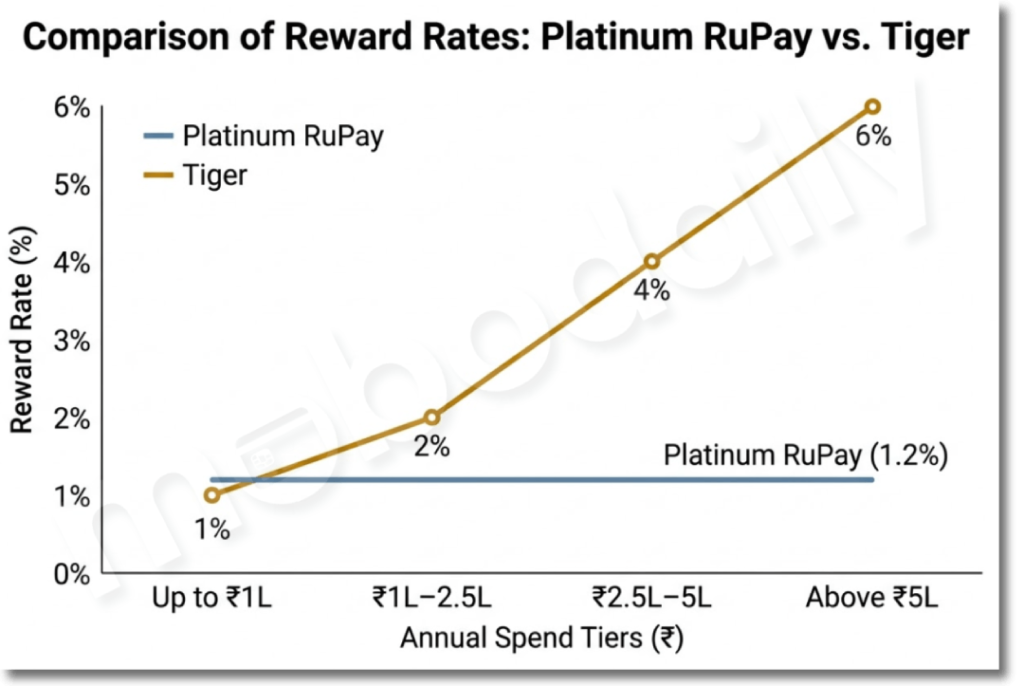
| Annual Spend | Platinum RuPay | Tiger |
|---|---|---|
| Up to ₹1L | 1.2% | 1% |
| ₹1L–2.5L | 1.2% | 2% |
| ₹2.5L–5L | 1.2% | 4% |
| Above ₹5L | 1.2% | 6% |
Platinum RuPay offers a better return if you spend below ₹1L a year via UPI.
While Tiger is better for heavy-spenders. For instance, it earns 20,000 RPs on ₹6L annual spend—a 3.33% effective return if you transfer points to Maharaja Club.

Redemption
| Redemption Route | Platinum RuPay | Tiger |
|---|---|---|
| Non-cash / catalogue | ₹0.60/point, no stated cap | ₹0.40/point (vouchers) |
| Cash credit | ₹0.35/point, capped 2,500 pts/month | ₹0.40/point, capped 5,000 pts/month |
| Airline transfer | KrisFlyer (4 RP = 1 mile) | Air India Maharaja Club (1:1), KrisFlyer (4:1) |
| Redemption fee | ₹0 | ₹0 |
Tiger’s redemption is stronger — mainly because of the Air India transfer, which Platinum RuPay simply doesn’t have.
But point-for-point, Platinum RuPay’s non-cash rate (₹0.60) is actually higher than Tiger’s (₹0.40). If you don’t care about Air India miles specifically, Platinum RuPay’s redemption isn’t the downgrade you’d expect.
Lounge, Travel & Other Perks
| Benefit | Platinum RuPay | Tiger |
|---|---|---|
| Domestic Lounge | None | 8/year, no spend condition |
| International Lounge | None | 2/year (Priority Pass) |
| Golf | None | 4/year |
| Movies | None | 2/year, up to ₹500 |
| Rent via UPI | No extra fee | – |
| Travel Insurance | ₹1L baggage, ₹25k delay / lost ticket / missed flight, ₹50k passport, ₹25L air accident cover | Not published |
This is where Tiger’s advantage is real and uncontested — lounge access, golf, and movies simply don’t exist on Platinum RuPay.
However, Platinum RuPay uniquely offers bundled travel insurance and avoids extra charges on UPI rent payments, which Tiger lacks.

Eligibility & Application
| Criteria | Platinum RuPay | Tiger |
|---|---|---|
| Who can apply | Only customers with no existing IndusInd credit card | Open to new applicants and existing customers (upgrade or fresh apply) |
| Age | ~21–60 yrs | ~21–60 yrs |
| Income (unofficial) | ~₹20k–30k/month | ~₹20k–35k/month |
Platinum RuPay is strictly a first-card product — existing IndusInd cardholders are ineligible, making it the default entry point while Tiger serves as an upgrade.
However, upgrading from Platinum to Tiger is often difficult and may require written escalation.
Which One Should You Get?
| Your Priority | Better Card |
|---|---|
| UPI spends | Platinum RuPay |
| Air India Maharaja Club miles | Tiger |
| Lounge access, golf, movies | Tiger |
| Low forex markup | Tiger |
| High, consistent annual spend (₹5L+) | Tiger |
Final Verdict
Both are great lifetime free cards by IndusInd, choose based on your spending profile.
Choose Platinum RuPay if: Your primary goal is maximizing UPI rewards at lower spend levels. It is the superior, no-nonsense earner for everyday transactions.
Choose Tiger if: You want a premium lifestyle package. Tiger is the objective winner for travel enthusiasts who value lounge access, golf, and Air India miles, or if your annual spend consistently exceeds ₹5 lakh, where its slab-based rewards outperform the flat rate.
Ultimately, Platinum RuPay is your daily driver; Tiger is your travel companion. Align your choice with your lifestyle, not the hype.
Disclaimer: This post reflects my own experience with both cards and is for informational purposes only, not financial advice. Some links are affiliate links — I may earn a commission if you apply through them, at no extra cost to you. Fees, rates, and reward terms can change; please verify current details on the issuer’s official page before applying. Read full privacy & disclaimer here.

- Scapia Credit Card Review 2026 — Best Lifetime Free Card? - October 2, 2026
- Scapia vs BOBCARD Eterna Credit Card 2026 - October 2, 2026
- Scapia Credit Card Referral Program — Link & Benefits - September 2, 2026