

MCX Gold has crashed by ₹14,000 per 10g, and Silver has plummeted by ₹33,000 per kg just this week.
With the ongoing US-Iran war, you must be wondering: why are gold and silver bleeding despite being the ultimate safe-haven assets? How much deeper will this correction go?
Become a Stock Market PRO!
Join @Mobodaily Telegram Channel Get high-quality swing trading ideas (averaging 10%+ returns), daily market news & crucial IPO reviews.
And most importantly, should you sell your holdings right now or buy the dip?
In this post, I have explained the current situation in 5 phases to give you a clear roadmap on what to do with your capital next.
Phase 1: Energy crisis
It has been exactly three weeks since the Strait of Hormuz—the chokepoint for roughly 20% of global oil consumption—was effectively blocked.
This is not a localized, traditional conflict like Russia vs. Ukraine; this has triggered the biggest global energy crisis in history. It is officially larger than the 1973 oil shock and the 1990 Gulf War. The International Energy Agency (IEA) has already labeled the current situation the largest supply disruption on record.
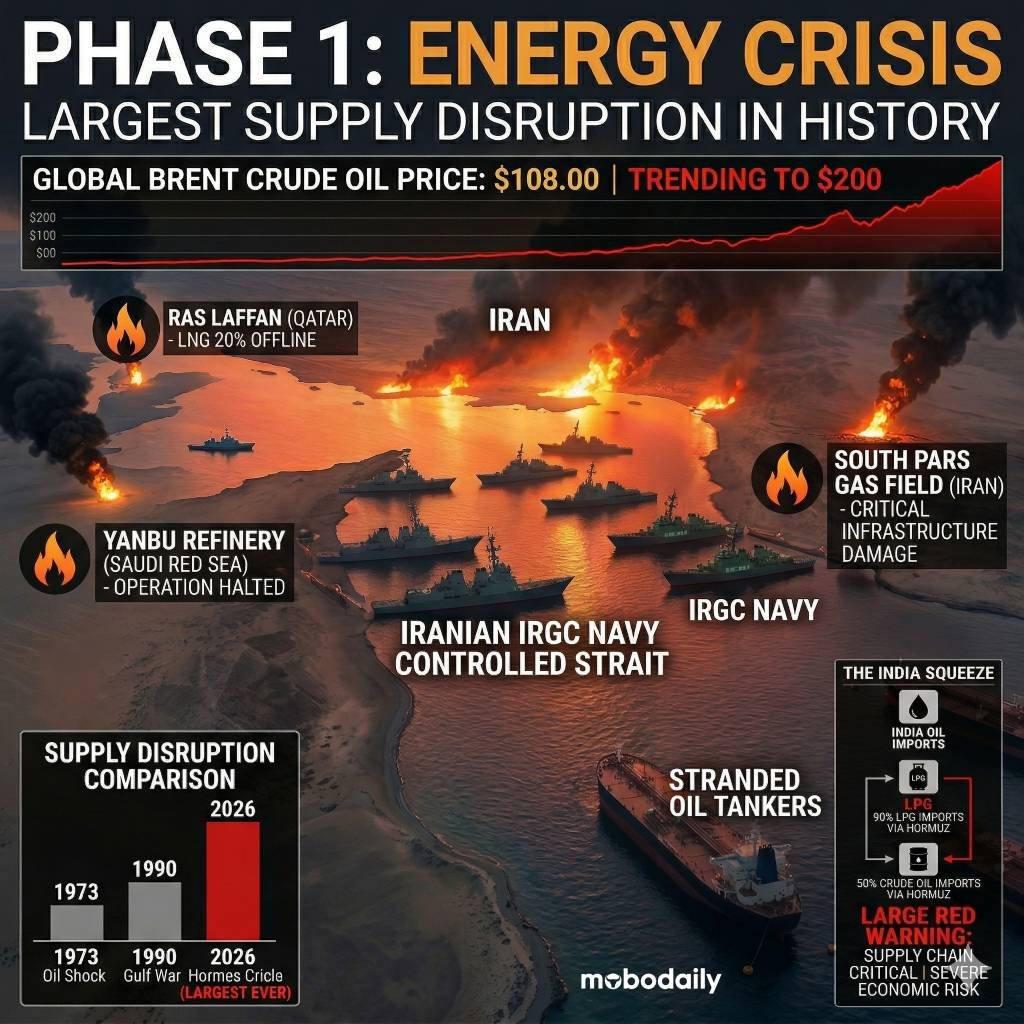
Crude oil has easily surpassed the $100 mark, with analysts warning it could touch $200 if the conflict escalates.
Worse, this is no longer just a shipping blockade; it is the physical destruction of global energy capacity. Over the last week, targeted missile strikes have severely damaged Qatar’s Ras Laffan facility (which processes 20% of global LNG), forced Saudi Arabia and the UAE to halt operations at mega-refineries like SAMREF and Ruwais, and crippled Iran’s own South Pars gas field.
For India, the stakes are incredibly high: Strait of Hormuz facilitates approximately 90% of our LPG imports and 50% of our total crude oil requirements.
Phase 2: The Petrodollar Squeeze (The Strong USD)
The birth of petrodollar
In 1974, the US struck a masterstroke deal with Saudi Arabia (and eventually all of OPEC): the US would provide military protection, and in exchange, the Gulf nations would exclusively sell their oil in US Dollars.
This birthed the “Petrodollar.” Today, if any country wants to buy global oil, they must use US Dollars.
The inelastic oil demand trap
Here is where the trap closes. The demand for oil is inelastic because our economy can’t survive without oil, gas, and other petrochemicals.
- In simple words, India has to buy crude oil and LNG irrespective of the price.
- We can’t halt our oil purchases just because of supply disruptions or high prices.
- Importing countries like India, Japan, and South Korea unwillingly have to increase their USD reserves to buy the oil to satisfy their household and industry consumption.
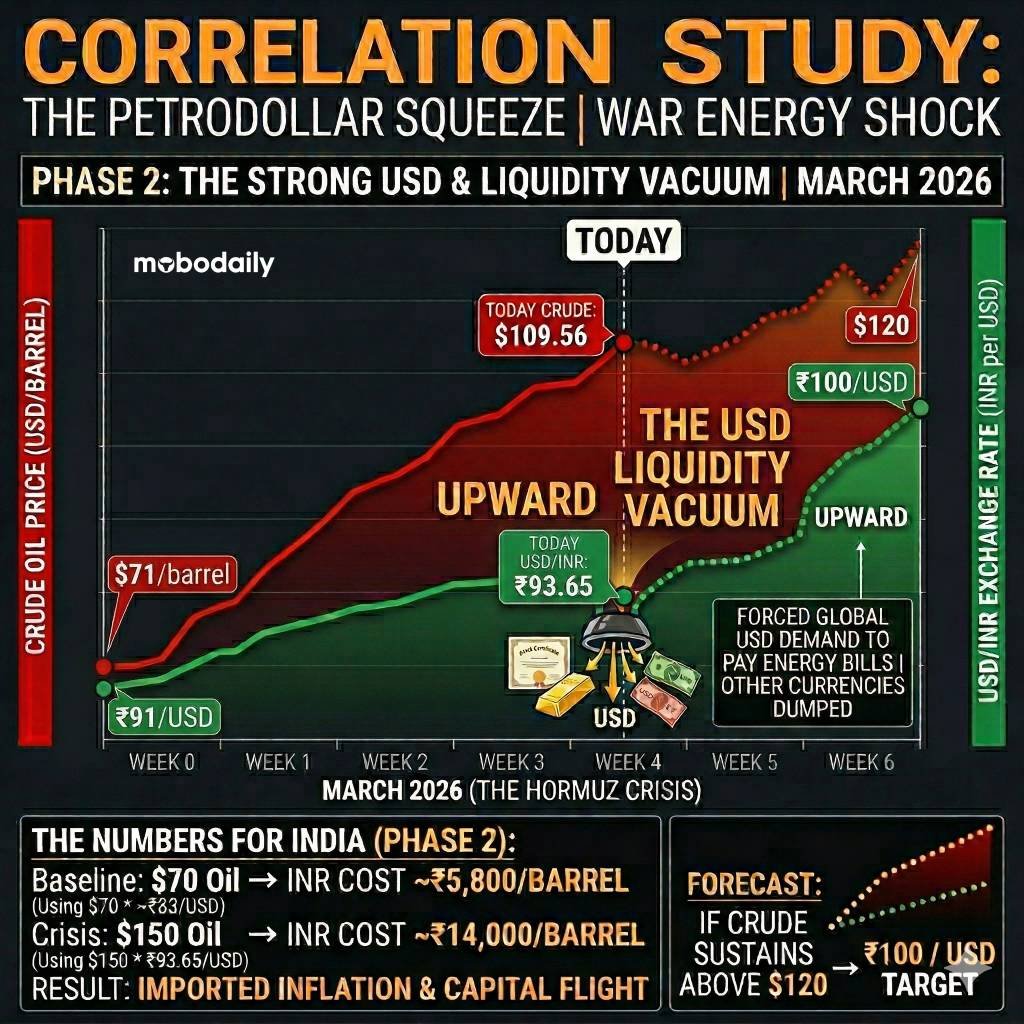
For example, before this crisis, India needed around $70 to buy a single barrel of crude. Today, due to the war, India needs well over $100—and potentially $150+—to buy that exact same barrel.
This means every oil-importing nation on earth has to aggressively increase its USD reserves just to pay their bloated energy bills.
The result: global liquidity vacuum
This massive, forced demand for the Dollar is what makes the USD skyrocket against the Rupee and other currencies.
Indian Rupee has already touched the record low of ₹93.65/USD and is expected to touch the ₹100 mark soon if the Crude sustains above $120 per barrel.
Phase 3: Liquidity Crunch & Capital Adjustment
This is the phase where aggressive selling hits gold and silver. Despite being safe-haven assets, they are crashing due to two massive macroeconomic forces:
1. The Liquidity Crunch (Cash is King)
Global economies are facing a severe liquidity crunch. Because of the petrodollar squeeze, they desperately need US Dollars to pay for their wildly expensive oil imports.
- To raise this cash, institutions are forced to liquidate all major capital assets—including equities, gold, and silver.
- In short, Gold and Silver are being sold simply to fulfill immediate cash requirements. They have NOT suddenly become fundamentally “bad” assets; they are just the most liquid assets available for institutions to dump when they need dollars fast.
2. Capital Adjustment (The Interest Rate Trap)
When crude prices skyrocket, global inflation rises with it. Everything becomes expensive, from durable goods to food and all petroleum-based products.
- To manage this surging inflation, central banks are forced to pivot. Instead of cutting interest rates to boost the economy, they must pause rate cuts or even hike them.
- The Fed Pivot: Just weeks before this war, the bullion market was fully expecting 2 rate cuts this year. But in the recent March US Fed meeting, the Fed hit a hard pause and indicated there might be zero rate cuts this year due to the energy shock.
- The Yield Disadvantage: Interest rates are inversely related to precious metals. Gold and silver are “non-yielding” assets—they don’t pay you monthly interest like US Treasury bonds do. When rates stay high, these metals become much less attractive.
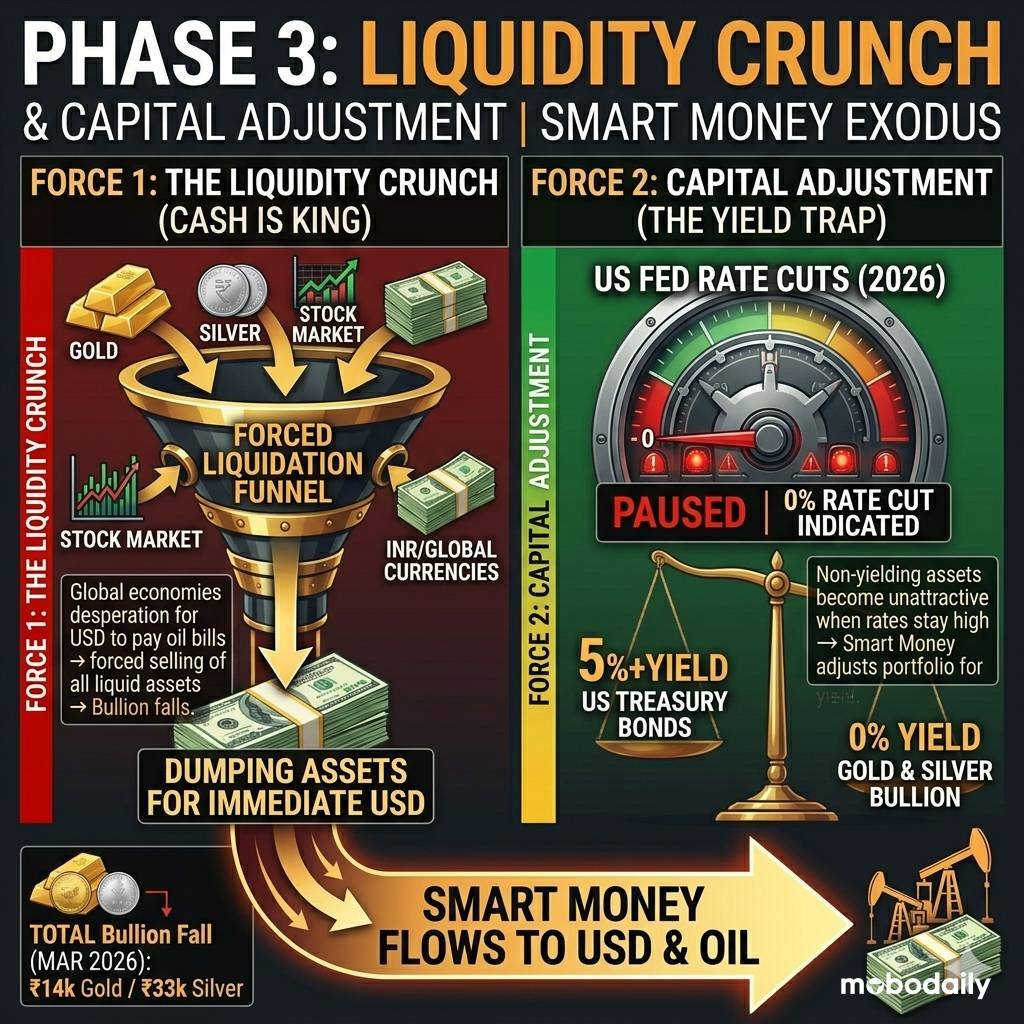
As a result of this capital adjustment, “Smart Money” pulls its capital out of gold and silver and moves it directly into the US Dollar and oil.
Phase 4: Economic Slowdown (Demand Destruction)
Even if the war cools down tomorrow and the Strait of Hormuz reopens, the damage has already been done. We are now entering the “Economic Slowdown” phase.
The Physical Infrastructure Collapse
The market initially priced in a temporary blockade, but the latest data confirms long-term physical destruction to the global energy grid:
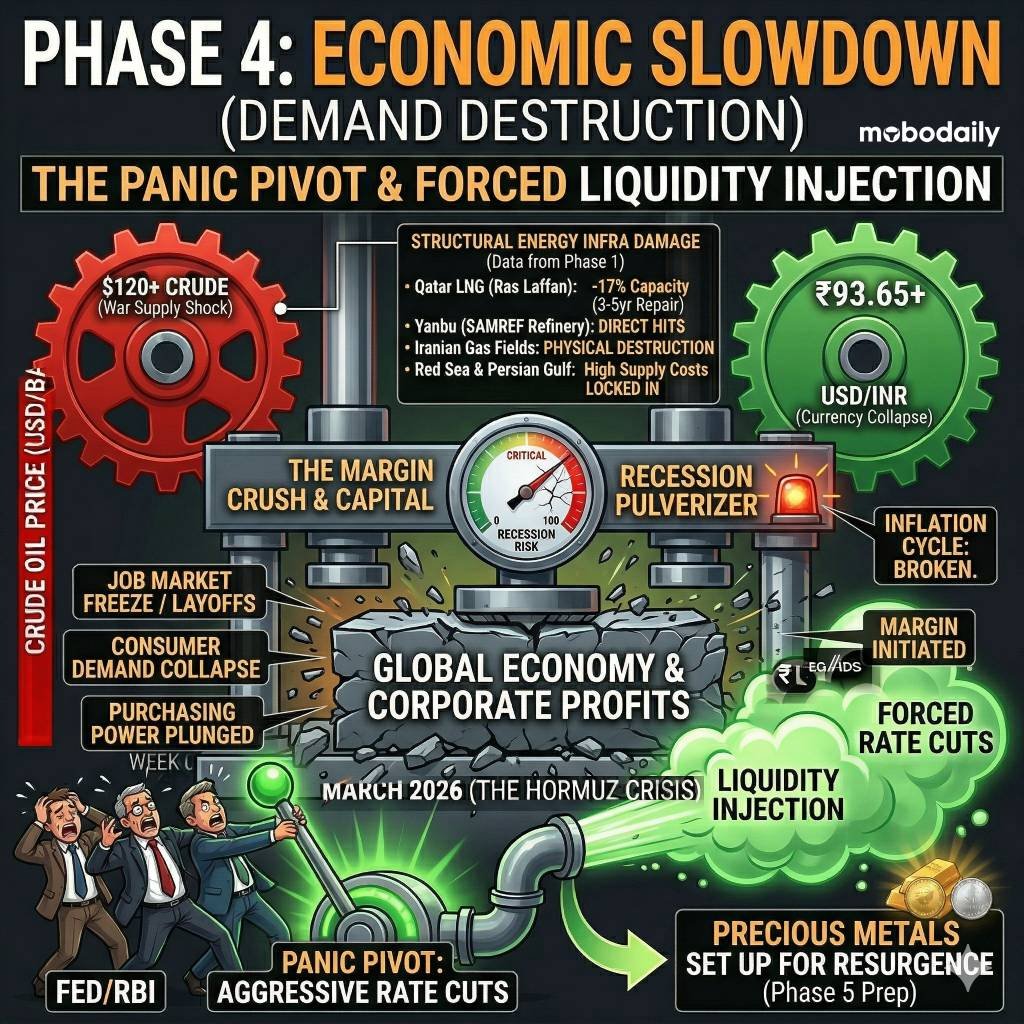
- Qatar’s LNG Crippled: Missile strikes on Qatar’s Ras Laffan—the world’s largest LNG hub—have caused “extensive damage,” wiping out roughly 17% of the country’s export capacity. QatarEnergy officially estimates repairs will take 3 to 5 years, creating a massive, prolonged global gas shortage.
- Regional Refining Hit: Critical downstream assets, including Saudi Arabia’s SAMREF refinery in the Red Sea port of Yanbu and Iran’s massive South Pars gas field, have sustained direct hits.
- Because of this physical destruction, the energy shock is no longer just a temporary war premium. High supply costs are structurally locked in for years.
The Severe Cash Drain
The prolonged period of $120+ crude oil and a crushed Rupee (₹93.65/USD) completely drains excess liquidity from the market. The high cost of survival leaves both businesses and regular households critically short on cash.
This lack of cash triggers a vicious cycle in the broader economy:
- Purchasing Power Plunges: Because imported inflation eats away everyone’s savings, consumer demand for non-essential goods, real estate, and capital assets collapses.
- Earnings Crash: With consumer demand falling and operating costs sitting at all-time highs, corporate profit margins are crushed.
- Job Market Freezes: To survive the margin crush, companies stop expanding, freeze hiring, and eventually begin layoffs.
The Central Bank Panic (Forced Rate Cuts)
This sounds incredibly bearish, but for precious metals, this severe economic contraction is actually positive for gold and silver.
This painful economic slowdown is exactly what breaks the inflation cycle. When the economy is on the brink of a deep recession and jobs are being lost, central banks (like the US Fed and the RBI) can no longer afford to keep interest rates high or locked at zero cuts.
To prevent a total economic collapse, they are forced to panic, pivot, and start aggressively cutting interest rates to pump liquidity back into the system.
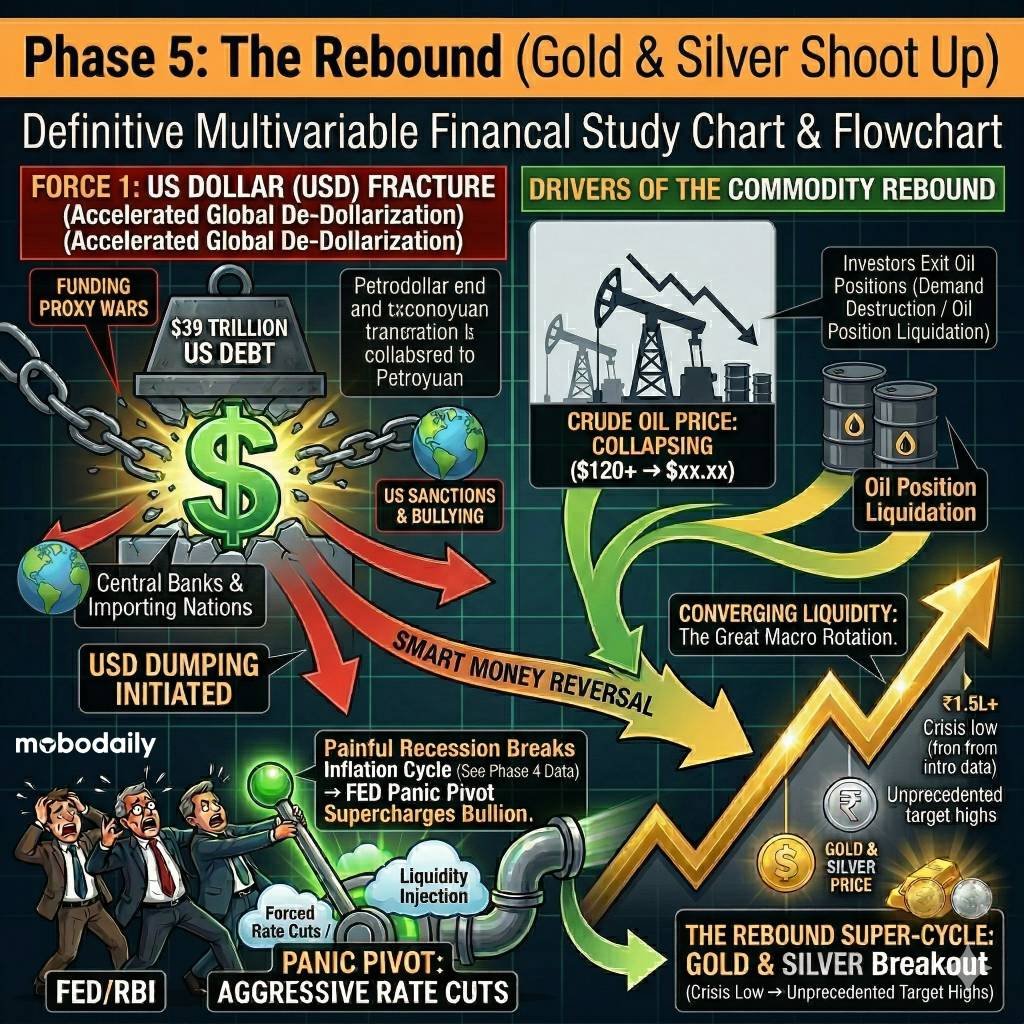
Phase 5: The Rebound (Gold & Silver Shoot Up)
As soon as the market prices in a cooling of the war and the inevitable central bank rate cuts, the liquidity crunch ends.
This triggers the final phase: the massive resurgence of precious metals.
The Smart Money Reversal
With interest rates falling and the economy stabilizing, the “yield trap” disappears.
The Smart Money that was forced to flee into cash violently rotates back into Gold and Silver. The traditional safe-haven demand resumes, but this time, it is supercharged by a fundamental distrust of fiat currency.
Dedollarization Returns with a Vengeance
The US is currently sitting on a staggering $39 trillion of national debt.
Funding proxy wars and absorbing the shock of inflated energy costs will push that deficit to unsustainable levels.
- As the immediate panic subsides, global trust in the heavily inflated US Dollar will shatter.
- Importing nations—exhausted by the petrodollar squeeze, US sanctions, and the forced devaluation of their own currencies—will actively dump their excess USD reserves.
- To protect their sovereign wealth, central banks will move that massive wave of liquidity directly back into physical Gold.
The End of the Petrodollar?
The ultimate bullish catalyst for Gold lies in the Strait of Hormuz. If Iran maintains control on Hormuz or severe influence over this critical chokepoint for an extended period, the 1974 Petrodollar agreement is in fatal danger.
Iran is already pressing importing nations to bypass the US Dollar entirely, pushing them to settle oil trades in the Chinese Yuan (the Petroyuan).
If global energy is no longer exclusively priced in USD, the fundamental pillar of Dollar dominance crumbles. This systemic shift would trigger a massive, structural dumping of the Dollar, sending Gold and Silver into an unprecedented, multi-year supercycle.
Conclusion (What to do?)
Hold physical gold and silver with confidence. If you have cash, keep investing systematically.
The geopolitical energy shock has forced a central bank pivot, triggering massive global de-dollarization. Smart money is already rotating out of the fracturing US Dollar and into hard assets for this multi-year super-cycle.
As Warren Buffett famously advised: “Opportunities come infrequently. When it rains gold, put out the bucket, not the thimble.”
The fundamentals have never been stronger. Ignore the short-term noise and let this macro rotation do the heavy lifting for your portfolio.

Beyond his passion for SEO and content creation, Kushal is also an experienced trader and investor with over six years of experience in the financial markets, specializing in swing and intraday trading of stocks, futures, and options.
- Why Gold & Silver Are Falling During US-Iran War? What to do? - March 22, 2026
- Top 7 Stock Market Advisors India 2026 (SEBI-Registered) - March 15, 2026
- Top 10 Best MCX Tips Providers India 2026 (Free) - March 14, 2026
Discover more from Mobodaily
Subscribe to get the latest posts sent to your email.